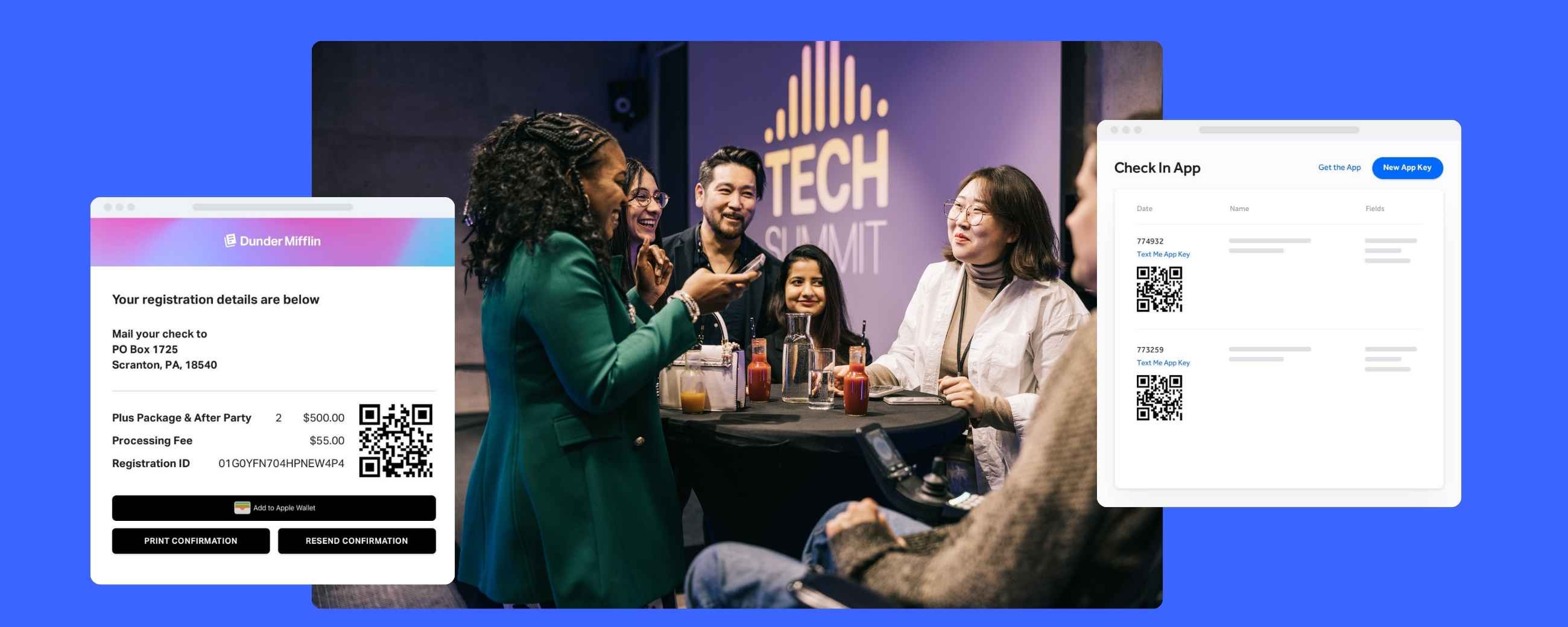
If you’ve ever watched a check-in line grow longer by the minute while your team scrambles behind the table, you already know how quickly the first moments of an event can go sideways. Names are hard to find, people arrive all at once, and even a small delay gets amplified when hundreds of attendees are walking through the door.
QR code registration isn’t about novelty. It’s about speed, accuracy, and reducing friction at scale. When check-in runs smoothly, everything else feels easier. QR codes solve a very real operational problem: getting people through the door quickly, correctly, and without unnecessary stress, especially when bottlenecks would hurt the experience.
For events with hundreds or thousands of attendees, QR code registration turns check-in from a bottleneck into a smooth first impression.
What QR Code Registration Means for Events (and Why Teams Use Them)
In practice, QR code event registration is straightforward. Each attendee is issued a unique, scannable QR code that’s tied directly to their registration record. That code can appear in a confirmation email, on a mobile ticket, or printed on a badge.
At check-in, staff scan the QR code and instantly pull up the correct record. There’s no searching alphabetized lists, flipping through paper, or manually typing names while a line builds behind the table. As a result, errors decrease, and check-in lines keep moving, even during peak arrival windows.
If you’ve ever experienced a manual check-in breakdown under real-world pressure, when everyone is arriving, you’re not alone. Event organizers love using QR scanning because attendees can check in within seconds, attendance is recorded automatically, and it lowers staffing requirements. The result is a calmer check-in environment and a more professional first impression that sets the tone for the entire event.
Where QR Codes Fit in the Registration Journey
QR codes are most effective when they’re part of a connected workflow, not a one-off tool. When used end-to-end, they support the full lifecycle of an event.
1️⃣ Registration
An attendee registers and is automatically issued a unique QR code tied to their record.
2️⃣ Confirmation
That same QR code appears on the confirmation page and in confirmation emails, making it easy for attendees to find when they arrive.
3️⃣ Badges and credentials
The QR code can be printed on a badge or credential ahead of time, supporting faster entry and re-entry for multi-day events.
4️⃣ On-site check-in
Staff scan the QR code to instantly pull up the correct registration record and mark attendance without manual searches.
5️⃣ During the event
QR codes can be reused for session tracking, access control, or other on-site workflows without introducing new tools.
6️⃣ Post-event follow-up
After the event, scan data supports accurate reporting, certificates, and follow-up communication.
When QR codes are woven through the full lifecycle, every scan serves a purpose beyond just opening the door.
Choosing the Right QR Code Setup for Your Event
Not all QR codes serve the same role, and choosing the right setup depends on how your event actually operates. Here are a couple of different QR code use cases:
Linking to a registration page works best for marketing and promotion. This approach removes friction for people who discover your event through signage, print materials, or partner locations and want to register immediately.
Encoding attendee credentials is useful when identity or access matters. This is common for events with restricted areas, ticket tiers, or credentials that need to be verified quickly and consistently.
Powering on-site check-in is the most common operational use. QR codes tied directly to registration records eliminate manual searches and allow staff to process arrivals quickly, even during peak entry times.
Smaller events may only need QR codes for check-in. Larger, multi-day, or multi-track events often benefit from using QR codes across registration, badges, and access points.
Designing QR Codes That Actually Get Scanned
Today, most people know how to use QR codes. Plenty of QR codes still fail, however, because they’re hard to scan in real environments. Beware of lighting, glare, or complex overlays, which can prevent scanning on badges or phone screens.
A high contrast, correctly sized code matters more than branding and style. If you want scanning to feel effortless, keep the design simple and let reliability win over aesthetics.
💡Pro tip: Before your event, make sure you’ve tested QR codes on multiple devices and in multiple scenarios. The more realistic the test, the fewer surprises you’ll have on-site.
QR Codes for On-Site Check-In
Picture this: it’s the morning of the conference. Attendees are arriving in waves, conversations are buzzing, and everyone is eager to get inside. This is where QR code check-in makes a huge difference.
The lines keep moving. Your staff doesn’t need to scramble; your attendees can scan, step forward, and head in without friction. Even when arrival times spike, check-in stays steady and predictable. When operations at the door run smoothly, everything feels easier for your team, and attendees feel well taken care of.
QR Codes on Badges and Credentials
Badges with QR codes become especially valuable as your event scales in size and duration. You might choose to use QR codes in any of the following ways.
➡️ Display QR codes on mobile confirmations for quick access.
➡️ Print QR codes on paper credentials for one-day events.
➡️ Embed QR codes on professionally printed badges for multi-day or high-volume events.
Clear instructions matter just as much as the badge itself. A simple prompt like “Please have your badge ready to scan” can dramatically improve flow and reduce hesitation at entry points.
Using QR Codes Across Marketing and Promotion
QR codes are most effective when they remove friction, not when they replace simpler actions.
Effective uses:
✅ Posters and signage that link directly to registration pages.
✅ Print materials at partner locations or venues.
✅ Event programs or physical mailers where clicking isn’t an option.
Ineffective uses:
❌ Emails where a clickable link is faster than scanning.
❌ Overcrowded designs where the QR code gets lost.
❌ Situations where attendees are already on their phones and scrolling.
Use QR codes where they make things easier, not just because they’re available.
Testing QR Codes Before Your Event
Testing QR codes is often an afterthought. Everyone assumes they’ll “just work.” But the best-run events treat testing as a priority, not a last-minute task.
A little time spent testing can save a lot of stress on event day.
✔️ Test scanning from different distances
✔️ Test under bright lights and dim lighting
✔️ Test printed codes and on-screen codes
✔️ Test damaged or folded prints
✔️ Test offline mode and backup workflows
If check-in matters to your event experience, testing is worth the effort.
Using QR Codes During and After the Event
QR codes can continue adding value long after the initial check-in.
During the event, they can unlock schedules, session attendance tracking, downloadable resources, or feedback forms without forcing attendees into multiple apps or logins. After the event, the same scan data supports accurate attendance reporting, follow-up emails, certificates of completion, and internal planning for future events.
When QR codes are tied into your registration system, every scan contributes to cleaner data and better decisions.
QR Code Registration for Hybrid and Multi-Format Events
Hybrid events add complexity, but QR codes help keep data consistent. In-person attendees can be scanned on-site, while virtual attendees remain part of the same registration system. When everything lives in one place, reporting, communication, and follow-ups stay aligned even when formats overlap.
Where QR Code Registration Breaks Down Without the Right System
Here’s where organizers often run into trouble. QR codes look simple on the surface, but problems arise when the tools behind them don’t talk to each other.
❌ Here’s what to watch out for: Check-in data doesn’t sync right away.
❌ Staff are forced to export spreadsheets mid-event.
❌ Scanners work on one device but not another.
❌ Someone has to reconcile everything manually after the fact.
It’s rarely the QR code itself that fails. It’s the disconnected workflow around it.
How RegFox Makes QR Code Registration Simple at Scale
Instead of functioning as a collection of disconnected tools, RegFox is built as an end-to-end registration system that makes using QR codes simple and powerful. Here’s what you can expect to access:
🚀 Automatic QR codes for every registrant
📱 On-site check-in app for iOS and Android
📴 Offline scanning with automatic syncing
🖨️ Built-in badge printing options
📊 Real-time attendance data and reporting
Everything works together, from registration through post-event exports, without custom development or manual workarounds.
FAQs
How does QR code registration work for events in practice?
Each attendee receives a unique QR code tied to their registration record, which staff scan at check-in to mark attendance instantly.
How do I create a QR code for event registration without custom development?
Platforms like RegFox generate QR codes automatically as part of the registration and confirmation process.
What’s the difference between QR codes for registration and check-in?
Registration QR codes link people to sign up. Check-in QR codes identify individual attendees on-site.
Do QR codes work for large or multi-day events?
Yes, especially when paired with badge printing and offline-capable scanning.
What happens if an attendee forgets their QR code?
Staff can look them up manually in the check-in app and still complete entry quickly.
Can QR codes be used for both registrations and badges?
Yes. Many events use the same QR code across confirmation emails and printed badges.
How reliable is QR code check-in compared to manual methods?
When properly tested, QR scanning is faster and more accurate than paper lists or manual searches.
What software supports QR code registration and on-site check-in?
End-to-end platforms like RegFox are designed specifically for this workflow.
Why RegFox QR Code Registration Works Better Over Time
The value of QR code registration compounds across events. Cleaner data, faster operations, fewer mistakes, and a smoother attendee experience become the norm, not the exception.
If you’re ready to run faster check-ins and reduce on-site stress, you can get started with RegFox today, or reach out to our support team with questions.
We’re here to help you host your best event yet!
— The RegFox team